
On The Diet - Part One
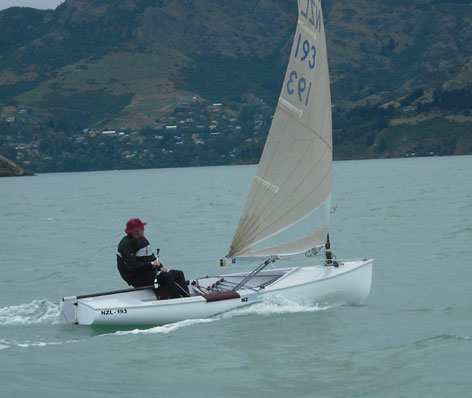
Having campaigned the Finn in its current mode for three years, problem areas were well established. With the rule change to permitting a hull weight reduction (to 116kg), the opportunity to put the Finn on a diet plus carry out modifications to rectify problem areas was taken. Target was to reduce the boat weight from the existing 120kg with no corrector weights to 114 Kg to enable the use of corrector weights to achieve better weight distribution and swing in the hull.
Problem Areas
1-.....By far the largest problem was the inability to funnel water out of the bow. To drain the forward
compartment a small one way flutter valve was used. That proved to be totally useless. So ended up just with a bung and while in
flat water sailing this proved not a problem, the 2009 Nationals in Lyttleton, with rougher and at times washing machine affect
conditions, showed up the inadequacies of the arrangement. Sailing with enough water in the bow to fill a bucket is not ideal.
2-.....Using blocks as the position adjustment in the bottom mast step made it easy to change mast setups on shore
but much more difficult proposition to make those adjustments out on the water.
3-.....Longitudinal flexing in the
centrecase capping allowing the centreboard to fall off. Even though the capping had been strengthened with a composite
carbon fibre and cedar support, the support was in the
longitudinal plane and the fabrication did not have the stiffness
desired.
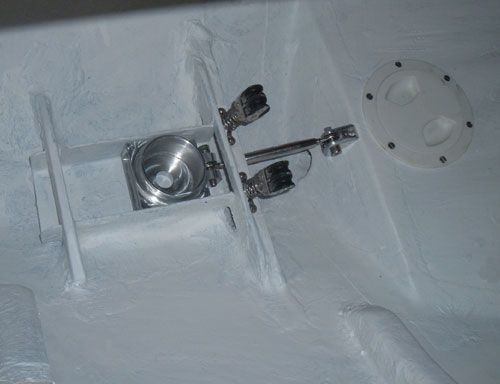
1-....The whole of the front of the bow section was redesigned by adding a
buoyancy tank in the bow, similar to the raised
floor concept of the Devoti. A tunnel allows free flow of water from the bow into the cockpit and out through the
self bailers. The boat only needs to be level to drain the now much smaller bow compartment back into the cockpit.
2-....The existing mast heel bearing slide was thrown away and a new concept of using a rockable bearing
cup (to slide in a carbon fibre slot) designed. Made adjustable by an 8mm rigging screw. See more details on installing the
V-Tech_307 -- Finn Heel Bearing Cup Set
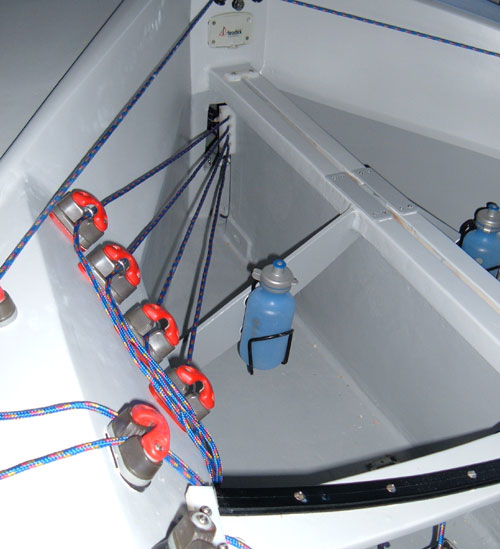
3-....The original concept, to ensure the centreboard remains centralised in the hull without any slop was sound,
but the flex remained in the centrecase capping.
Reduced the size of the centreboard locating blocks
to 50mm long and made them non adjustable. Removed alloy and carbon supports in the capping and replaced with fibreglass
retaining plates.
Side bracing supports installed using fibreglass and 3mm plywood sandwich.
This
stiffened the centrecase totally and had the added bonus of being able to relocate the drink bottles away from under
the thwart.
Weight savings was 1.1 kg in the bow and 0.8 kg on the centrecase supports. Much more is to come by attacking the
decks.
Follow On The Diet - Part Two.
